Water Tank Cleaning Service in India
India's Most Trusted Water Tank Cleaning Company
Professional overhead & underground water tank cleaning, sanitization and disinfection — across 700+ Indian cities.
Looking for a reliable water tank cleaning service near me? Clean Hub India is one of the country's fastest-growing water tank cleaning companies, delivering professional water tank cleaning services in India across 700+ cities. Whether you need residential water tank cleaning, home water tank cleaning, overhead water tank cleaning, underground water tank cleaning, water tank sanitization service, or a complete water tank disinfection service — we are your single-window solution for clean, safe and healthy drinking water.
Our network of trained water tank cleaning experts covers Delhi NCR, Ajmer, Mumbai, Bangalore, Chennai, Hyderabad, Kolkata, Pune, Ahmedabad, Jaipur, Lucknow, Chandigarh, Patna, Indore, Agra, Ambala, Bathinda, Firozpur, Ganganagar, Goa, Jammu, Kharar, Ludhiana, Mohali, Panipat, Pathankot, Patiala, Rajpura, Sangrur, Surat, Zirakpur, Shimla, Udaipur, Abohar, Nagpur, Amritsar, Ranchi, Coimbatore, Srinagar, Panchkula, Solan, Noida and Meerut — plus hundreds of smaller towns. If you searched for a water tank cleaning service near me or a water tank cleaners near me, you have found the right team.
💧 Same Day Water Tank Cleaning Available! Book before 11 AM and get your tank cleaned the same day. Affordable water tank cleaning starting at just ₹499. Call +91 76269 67828 now, or book online at cleanhub4u.in.
What Is Water Tank Cleaning? A Complete Definition
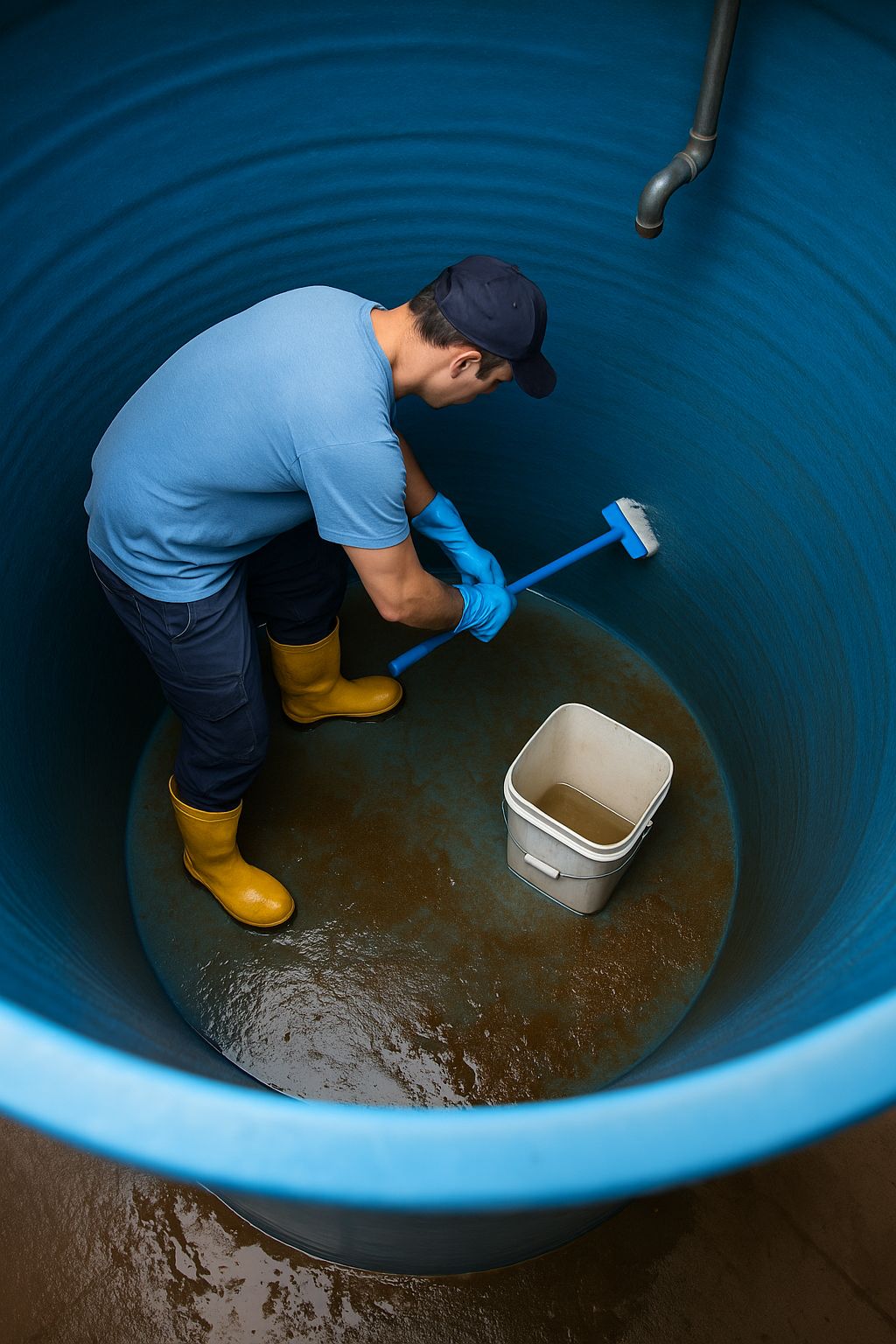
Water tank cleaning is the process of physically removing sludge, sediment, rust, algae, biofilm and organic debris from the interior surfaces of a water storage tank, followed by chemical sanitization or disinfection to eliminate pathogens. A proper water storage tank cleaning service is not just "washing the tank" — it is a multi-stage technical procedure that combines mechanical scrubbing, high-pressure jetting, vacuum extraction, chemical treatment and multiple fresh-water rinses.
A professional water tank washing service or water tank deep cleaning service differs from casual cleaning in three critical ways: it removes the biofilm layer that protects bacteria, it uses food-grade chemicals safe for potable water, and it documents the work with photographs and a written report. This is why our water reservoir cleaning service and water tank hygiene service are trusted by families, societies, hospitals, hotels and factories alike.
Why Professional Water Tank Cleaning is Absolutely Essential in India
Water is life — but contaminated water is a silent killer. Your overhead or underground water tank is a breeding ground for harmful bacteria, viruses, algae, fungus and parasites if it is not cleaned regularly. At Clean Hub, we have inspected tanks that had not been cleaned in years — filled with thick sludge, rust particles, dead insects, decaying organic matter and a sticky biofilm coating on the walls. Our professional water tank cleaning service ensures your family drinks, cooks and bathes in water that is genuinely safe and hygienic.
Most people do not realise that even municipal water, which is treated at the source, becomes contaminated once it enters your storage tank. Sediments settle at the bottom, algae grows on the walls in sunlight, and bacteria multiply rapidly — especially in India's warm and humid climate. This is exactly why our water tank cleaning experts recommend cleaning overhead tanks every 6 months and underground tanks every 12 months, and every 4 months if you live in a dusty or hard-water region such as Jaipur, Delhi NCR, Ahmedabad, Chennai or Ganganagar.
There is also a hidden cost angle. A dirty tank forces your water purifier to work harder, clogs geysers and washing machine inlets, stains bathroom fittings with iron and manganese deposits, and shortens the life of every water-using appliance in the home. A ₹499 cleaning can easily save you several thousand rupees in appliance repairs and RO membrane replacements over a single year. That is what makes affordable water tank cleaning service one of the highest-return home maintenance decisions you can make.
Finally, there is a legal and compliance angle for businesses. Hospitals, hotels, restaurants, schools and food processing units are increasingly required to maintain documented water safety records. Our commercial water tank cleaning and industrial water tank cleaning services provide GST invoices, service reports and water test results that satisfy auditors and health inspectors.
10 Warning Signs That Your Water Tank Needs Cleaning Right Now
- Foul or musty smell from tap water, especially in the morning after overnight stagnation.
- Cloudy, yellowish or brownish water when you first open the tap.
- Visible particles or sediment settling at the bottom of a glass of water.
- Metallic or bitter taste that was not there earlier.
- Green or black patches visible on tank walls (algae and mould growth).
- Skin irritation, itching or rashes after bathing.
- Hair fall and dandruff increasing without any change in shampoo or diet.
- Frequent stomach upsets or loose motions in the family.
- Water purifier filters clogging much faster than the recommended replacement cycle.
- Mosquito larvae or insects found near the tank lid or overflow pipe.
If you notice even two or three of these signs, book a water tank deep cleaning immediately. Delaying only allows the sludge layer to compact harder, which makes later cleaning more difficult, more time-consuming and more expensive.
Health Risks of Not Cleaning Your Water Tank — A Detailed Look
Contaminated stored water is responsible for a surprisingly large share of preventable illness in Indian households. Below is a breakdown of the specific risks our water tank disinfection service is designed to eliminate.
1. Waterborne Diseases
Stored water in uncleaned tanks can harbour Salmonella typhi, Vibrio cholerae, Shigella, E. coli, Entamoeba histolytica and Hepatitis A virus. These cause typhoid, cholera, bacillary dysentery, amoebiasis, gastroenteritis and jaundice. Children under five and elderly family members are at the highest risk of severe dehydration and hospitalisation.
2. Skin and Hair Problems
Bathing in bacteria-laden water causes folliculitis, eczema flare-ups, fungal infections such as ringworm, and persistent itching. Hard-water minerals combined with organic sludge strip natural oils from the scalp, leading to dandruff, scalp acne and increased hair fall. This is a very common complaint among residents of hard-water cities like Jaipur, Chennai, Ahmedabad, Ganganagar and Coimbatore.
3. Respiratory and Allergic Reactions
Mould spores from algae-covered tank walls become airborne in bathrooms during hot showers. This can trigger asthma attacks, allergic rhinitis and chronic coughing, particularly in children.
4. Dental and Oral Health Issues
Using contaminated water for brushing introduces bacteria directly into the gums, causing gingivitis, bad breath and dental cavities.
5. Appliance and Plumbing Damage
Sediment and scale block geyser heating elements, washing machine inlet valves, dishwasher pumps and RO pre-filters. Iron and manganese deposits stain white bathroom tiles and sanitaryware permanently. Regular water tank maintenance service dramatically extends appliance life.
6. Mosquito Breeding and Vector-Borne Disease
Poorly sealed or partially filled tanks become ideal breeding sites for Aedes aegypti, the mosquito that transmits dengue, chikungunya and Zika virus.
7. Food Contamination
Water used for cooking, washing vegetables, preparing baby formula and making ice can transfer pathogens into food, causing repeated family-wide infections that are hard to trace.
Types of Water Tanks We Clean — Complete Coverage
Clean Hub's water tank cleaning company handles every tank material, shape and capacity found in India. Our equipment and chemicals are matched to the tank type so there is never any damage to the structure or the stored water.
🏠
Overhead Water Tank
Rooftop plastic, HDPE, RCC and Sintex-style tanks in homes, villas and apartments.
⬇️
Underground Sump Tank
Basement and below-ground concrete sumps, often the dirtiest and most neglected.
🧱
Concrete / RCC Tank
Poured-concrete tanks with rough interior walls requiring intensive scrubbing.
🪣
Plastic / HDPE Tank
Triple-layer, single-layer and insulated plastic tanks — scratch-free cleaning methods.
⚙️
Stainless Steel Tank
SS 304 and SS 316 tanks common in hotels and food-processing units.
🛢️
FRP / GRP Tank
Fibre-reinforced panel tanks used in apartments and industrial plants.
🏢
Society & Apartment Tanks
Multi-tank systems with common overhead and underground storage.
🏭
Commercial & Industrial
Hotels, hospitals, schools, factories, hostels, malls and construction sites.
🚛
Water Tanker & Bowser
Mobile tanker tanks used for supply in water-scarce areas and events.
Overhead Water Tank Cleaning Service — Rooftop & Terrace Tanks
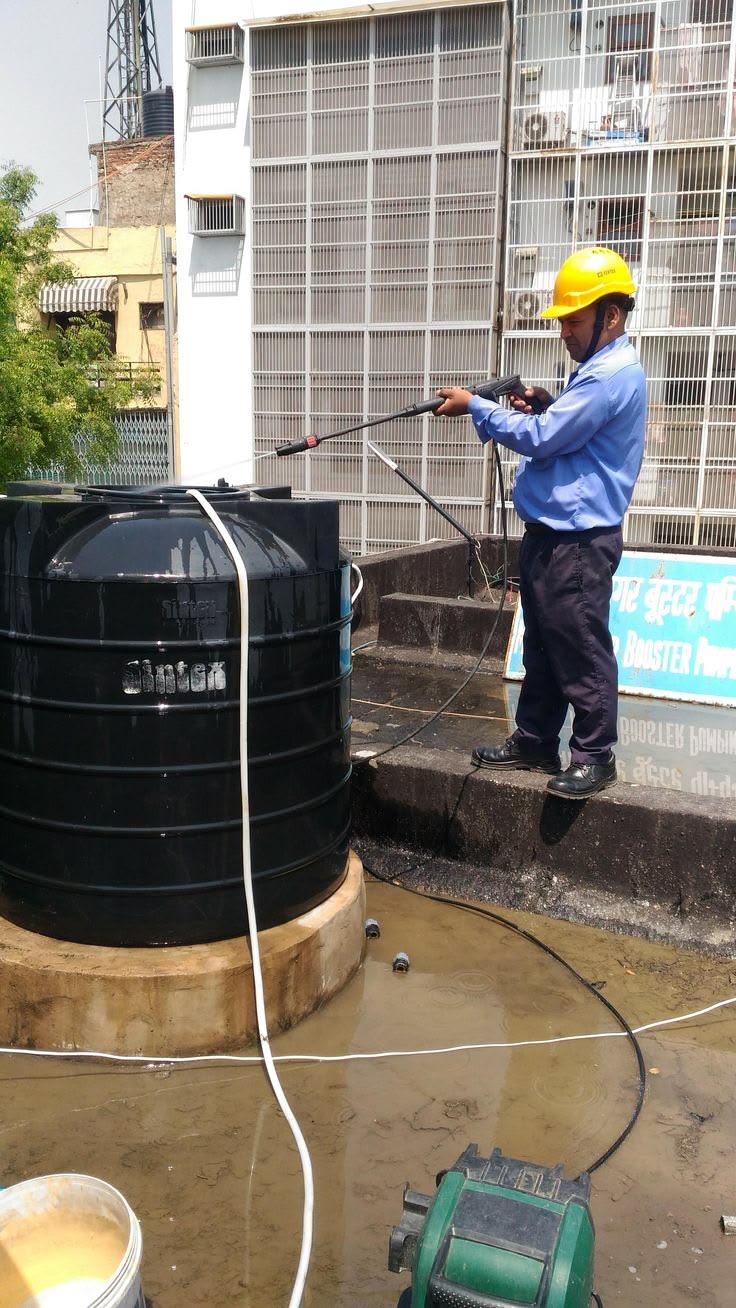
Overhead tanks on your rooftop are the most common type of water storage in Indian homes. Because they sit in direct sunlight, they are especially prone to algae growth, which turns tank walls green and gives water an earthy taste. Our overhead water tank cleaning service and rooftop water tank cleaning uses a systematic approach: complete draining, high-pressure machine scrubbing, manual wall cleaning, sludge removal, antibacterial treatment and final rinse.
We also inspect for leaks, cracks and structural damage — giving you a free waterproofing assessment that can save you from expensive seepage repairs later. Whether you have a small 500-litre plastic water tank on a terrace or a 5,000-litre RCC overhead tank on a commercial building, our terrace water tank cleaning team has the ladders, harnesses and equipment to do the job safely.
Underground Water Tank Cleaning Service — Sumps & Reservoirs
Underground tanks and sumps are darker, cooler and more prone to bacterial growth. Because they receive water first from the municipal line, they collect the highest concentration of sediment, iron particles and organic matter. Our underground water tank cleaning service is conducted by trained professionals using specialised safety equipment including harnesses, oxygen monitoring and industrial-grade scrubbers.
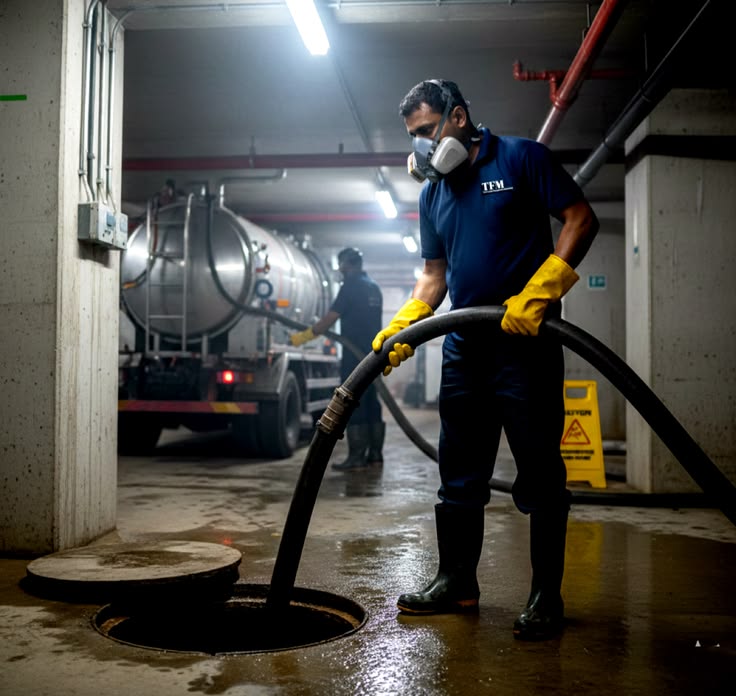
We remove years of accumulated sludge, mud and sediment from underground water storage tanks and underground water reservoirs, then perform complete disinfection. For deep sumps that have never been cleaned, we use industrial wet vacuum extractors with HEPA filtration to lift compacted sediment that ordinary pumps cannot move. This is the most demanding category of water tank sludge removal and it should never be attempted without confined-space training.
Water Tank Sanitization Service — Bacteria, Virus & Biofilm Elimination
Our water tank sanitization service uses food-grade, chlorine-free chemicals that eliminate 99.9% of bacteria, viruses and pathogens. The treatment is safe for children, pets and elderly family members. We also apply a protective anti-algal treatment that inhibits future bacterial growth for up to six months, which means your next cleaning will be easier and your water stays fresher for longer.
Sanitization is the stage that most cheap local cleaners skip. Without it, you get a visually clean tank that still harbours invisible pathogens on its walls. That is why we treat water tank cleaning and sanitization as a single indivisible service rather than two separate add-ons.
Water Tank Disinfection Service — Hospital & Food-Grade Standards
For hospitals, hotels, clinics, schools and food processing units where hygiene standards are critical, our water tank disinfection service uses advanced UV and ozone treatment. This method is chemical-free and provides long-lasting protection against waterborne diseases. Ozone treatment is particularly effective against biofilm, the slimy layer that protects bacteria from ordinary disinfectants.
We also offer water tank chlorine cleaning and water tank chemical cleaning with measured chlorine shock dosing for heavily contaminated tanks, post-flood situations and specific compliance requirements — always followed by mandatory de-chlorination, flushing and clarity testing before the tank is returned to service. Our water tank sterilization service is used by dialysis units, pharmaceutical plants and neonatal wards where water quality is non-negotiable.
Mechanized & Machine-Based Water Tank Cleaning
Manual cleaning with a bucket and broom simply cannot reach the corners, ceiling and inlet nozzles of a tank, and it cannot remove biofilm. That is why Clean Hub uses mechanized water tank cleaning and mechanical water tank cleaning methods built around professional equipment.
- Water tank high pressure cleaning — 100 to 150 bar jet washers with adjustable nozzles that lift compacted scale without damaging tank walls.
- Water tank vacuum cleaning — industrial wet-and-dry vacuums with HEPA filtration for complete sludge and sediment extraction.
- Water tank suction cleaning — submersible and portable drainage pumps that empty large sumps quickly.
- Water tank scrubbing service — soft rotary brushes and food-grade hand brushes for corners, joints and manhole rims.
- Water tank pressure washing — for RCC and concrete tanks where rough surfaces trap sediment.
If you have been searching for a water tank cleaning machine near me or a water tank cleaning machine service, you actually need a team that owns and operates that machinery — and that is exactly what we provide. Our water tank cleaning equipment list includes jet washers, rotary scrubbers, ozone generators, UV-C units and digital TDS/pH testing kits.
Sludge, Algae, Rust & Sediment Removal — The Core of Deep Cleaning
The visible dirt is only part of the problem. Here is what our water tank deep cleaning actually removes:
Water Tank Sludge Removal
Compacted mud, silt and organic matter that settles at the bottom over months and years, often 20–100 kg in neglected sumps.
Water Tank Algae Removal
Green and black algal growth on sunlit walls, plus the anti-algal treatment that prevents regrowth for up to six months.
Water Tank Rust Removal
Iron oxide flakes from old pipes and fittings, followed by descaling to stop staining of tiles and fittings.
Water Tank Sediment Removal
Fine suspended particles and grit that cloud the water and clog RO pre-filters and geyser elements.
Water Tank Fungus & Moss Cleaning
Mould, fungus and moss growth in damp corners and under lids, a common cause of musty smell and allergies.
Water Tank Bacteria Cleaning
Pathogenic bacteria eliminated through sanitization and disinfection, verified with clarity and TDS checks.
Our 12-Step Professional Water Tank Cleaning Process
Every Clean Hub water tank sanitization service follows a documented 12-step protocol. Technicians are trained to follow the same sequence on every job, which is how we guarantee consistent results regardless of which city or team attends your booking.
Pre-Service Inspection
External and internal inspection, capacity and material check, "before" photographs captured.
Water Supply Isolation
Main inlet valve closed, pump switched off. Household supply continues from residual water.
Complete Drainage
Portable industrial pump drains the tank fully. Reusable water redirected for gardening.
Sludge Extraction
Thick sludge, rust flakes and organic debris removed with plastic scoops and wet vacuums.
High-Pressure Scrubbing
Walls, floor and ceiling scrubbed using 100–150 bar jet washers and soft rotary brushes.
Corner & Joint Detailing
Inlet nozzles, overflow pipes and manhole rims hand-scrubbed with food-grade brushes.
Drain Line Flushing
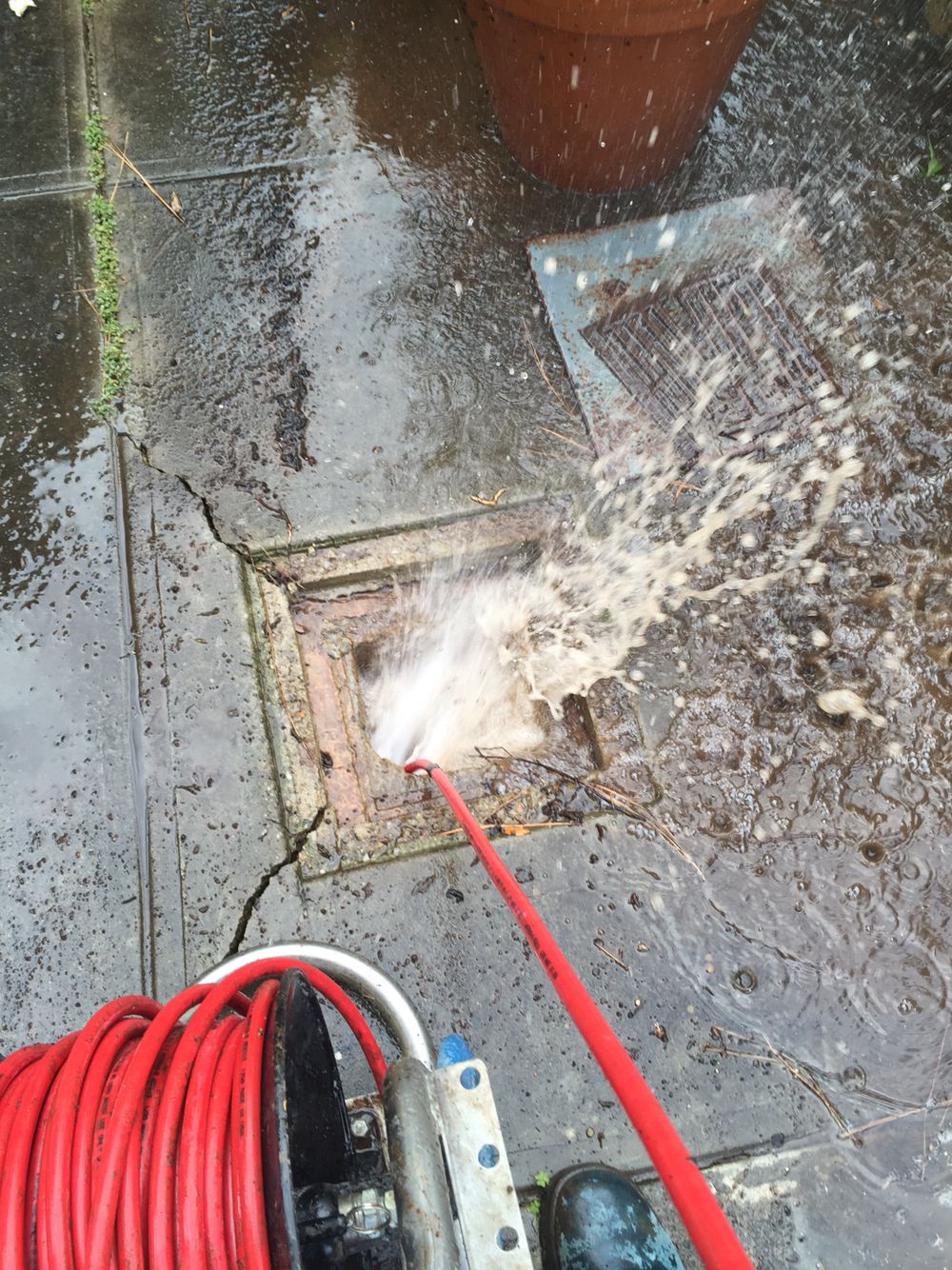
Inlet and outlet pipes flushed to remove sediment that would re-enter on first refill.
Antibacterial Sanitization
Food-grade, chlorine-free disinfectant sprayed on all internal surfaces for 99.9% kill.
Optional UV / Ozone
For hospitals and food units — chemical-free sterilisation using UV-C or ozone.
Multiple Fresh Rinses
Tank rinsed 2–3 times with clean water until all chemical residue is fully removed.
Structural Assessment
Cracks, damaged lids, broken vents and faulty float valves reported for repair.
Refill & Report
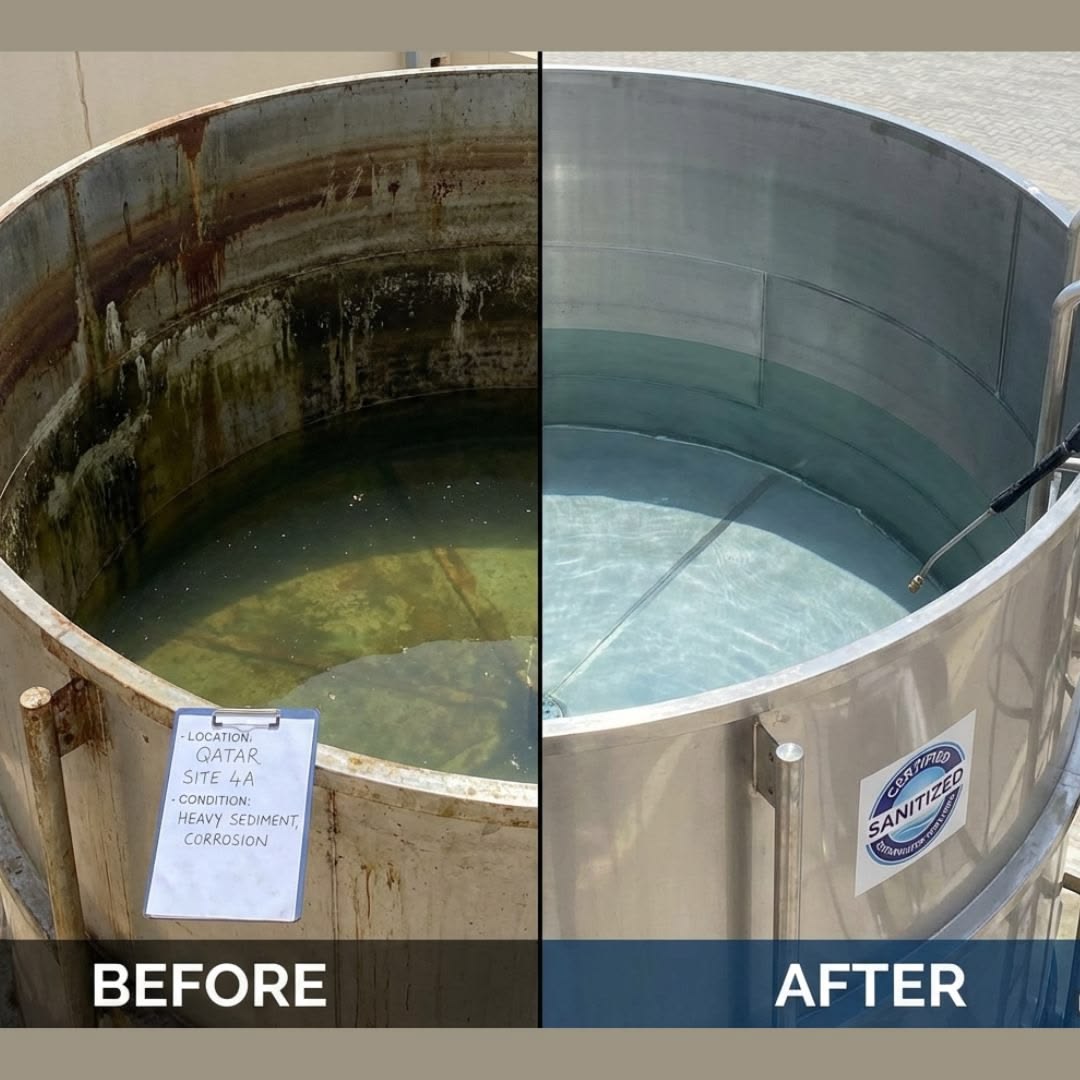
Tank refilled, water tested, before/after photos and warranty certificate delivered.
Chemicals & Equipment We Use — Safety First
Chemicals
- Food-grade sanitizers approved for potable water contact surfaces.
- Chlorine-free disinfectants that break down into harmless compounds.
- Descaling solutions for hard-water and iron deposits on concrete and RCC tanks.
- Anti-algal treatment that inhibits regrowth for up to six months.
- Optional chlorine shock treatment for heavily contaminated tanks, followed by de-chlorination.
Equipment
- High-pressure jet washers (100–150 bar) with adjustable nozzles
- Industrial wet-and-dry vacuum extractors with HEPA filtration
- Submersible and portable drainage pumps
- Soft rotary scrub brushes and food-grade hand brushes
- Ozone generators and UV-C sterilisation units
- Full safety gear — harnesses, non-slip footwear, gloves, respirators, confined-space gas monitors
- Digital water testing kits for TDS, pH and turbidity checks
Water Tank Cleaning Price List — Transparent & Fixed
All prices include labour, equipment, chemicals, transportation and GST invoicing. There are no hidden charges for "extra scrubbing", "chemical charges" or "height charges" — the quote you receive is the amount you pay. This is what makes Clean Hub the most affordable water tank cleaning service with genuinely transparent water tank cleaning rates.
| Tank Size | Type | Price | Time Taken | Warranty |
|---|
| 500 – 1000 L | Overhead Residential | ₹499 | 45–60 min | 30 days |
| 1000 – 2000 L | Overhead Home | ₹799 | 60–90 min | 60 days |
| 2000 – 3000 L | Overhead / Society | ₹1,199 | 90–120 min | 60 days |
| 3000 – 5000 L | Underground Sump | ₹1,499 | 2–3 hours | 90 days |
| 5000 – 10000 L | Commercial / Apartment | ₹2,499 | 3–4 hours | 90 days |
| 10000 – 25000 L | Industrial / Bulk | ₹4,999 | Half day | 90 days |
| 25000+ L | Industrial / Municipal | Custom Quote | 1–2 days | 90 days |
| Multiple Tanks | Society / Apartment | Up to 30% off | As scheduled | 90 days |
Add-on services: UV/ozone sterilisation from ₹599, descaling treatment from ₹699, chlorine shock treatment from ₹899, water quality testing report from ₹499. Combo discounts of 15–25% apply when you book water tank cleaning together with AC service, house deep cleaning or car detailing.
Water Tank Cleaning AMC — Annual Maintenance Contracts
For homes, societies, apartments, hotels, hospitals, schools, factories and offices, an AMC (Annual Maintenance Contract) is the most cost-effective way to guarantee clean water year-round. Our water tank cleaning AMC and water tank cleaning maintenance contract plans lock in your pricing, give you priority scheduling, and remove the burden of remembering cleaning dates.
| Plan | Cleaning Frequency | Ideal For | Indicative Cost |
|---|
| Home AMC | 2 cleanings per year | Individual homes & villas | From ₹2,499/year |
| Basic AMC | 1 cleaning per year | Small societies (under 30 flats) | From ₹9,999/year |
| Standard AMC | 2 cleanings per year | Mid-size societies (30–80 flats) | From ₹17,999/year |
| Premium AMC | 4 cleanings per year | Large societies (80+ flats) | From ₹32,999/year |
| Custom AMC | Monthly / Quarterly | Hotels, hospitals, institutions | On assessment |
Every AMC includes scheduled cleaning, sanitization, before/after photographs, written service reports, priority response within 24 hours, and locked-in per-cleaning pricing for the contract duration. This is our regular water tank cleaning service and monthly water tank cleaning offering for institutional clients.
Residential, Domestic & Home Water Tank Cleaning
Our water tank cleaning at home service brings the entire professional setup to your doorstep. We arrive with all equipment — high-pressure washers, industrial vacuums, scrubbers, safety gear and eco-friendly chemicals. Most residential tanks (500–2000 litres) are cleaned in 45–90 minutes, and we leave the area as clean as we found it.
For individual homes, villas and small apartments, our domestic water tank cleaning and residential water tank cleaning packages start at just ₹499. We clean the tank, sanitize it, check plumbing connections and provide a written report with before/after photographs. This is ideal for families who want a simple, affordable, no-hassle home water tank cleaning service.
We also handle house water tank cleaning for bungalows, flat water tank cleaning, villa water tank cleaning and PG water tank cleaning with multiple small tanks. If you have searched for water tank cleaning at home near me or doorstep water tank cleaning, our teams are available across all 43 cities listed on this page and hundreds more.
Society, Apartment & Commercial Building Water Tank Cleaning
Housing societies, apartment complexes and gated communities have unique requirements: multiple tanks, hundreds of residents, regulatory obligations and zero tolerance for supply disruption. Clean Hub offers dedicated society water tank cleaning service and apartment water tank cleaning service with a resident-friendly approach.
Our building water tank cleaning teams coordinate with the RWA or facility manager, clean tanks one at a time so supply is never fully interrupted, work early morning or late evening if preferred, and provide a consolidated report with photographs for the notice board. For residential complexes and commercial complexes we also offer quarterly water quality reports that can be shared with residents or auditors.
Our commercial water tank cleaning service covers commercial building water tank cleaning, office water tank cleaning, mall water tank cleaning, warehouse water tank cleaning and shop water tank cleaning. We offer scheduled maintenance contracts, GST invoices, dedicated account managers and after-hours or weekend scheduling so that employees and customers are never inconvenienced.
Institutional Water Tank Cleaning — Schools, Hospitals, Hotels & Factories
Different institutions have different water safety obligations. Clean Hub has specialist protocols for each.
- School water tank cleaning — scheduled during vacations, with child-safe chemicals and documented reports for school management committees.
- Hospital water tank cleaning — UV-C and ozone sterilisation for dialysis, sterilisation and neonatal units, with microbiological testing before and after.
- Hotel water tank cleaning — kitchen-grade water safety, minimal guest disruption, night-shift scheduling available.
- Restaurant water tank cleaning — FSSAI-aligned documentation for kitchen and drinking water storage.
- Factory water tank cleaning and industrial water tank cleaning — large-capacity tanks, process water segregation, safety permits and confined-space protocols.
- Hostel water tank cleaning and PG water tank cleaning — multi-tank systems cleaned without disrupting resident supply.
- Institution water tank cleaning — colleges, universities, ashrams, temples, government offices and NGO campuses.
DIY vs Professional Water Tank Cleaning — An Honest Comparison
| Aspect | DIY Cleaning | Clean Hub Professional |
|---|
| Equipment | Bucket, broom, cloth | High-pressure jet, industrial vacuum, rotary scrubbers |
| Sludge removal | Partial; bottom layer often left | Complete extraction including compacted sediment |
| Biofilm removal | Not possible with manual scrubbing | Removed by pressure jet + chemical treatment |
| Disinfection | Bleaching powder (risk of residue) | Food-grade, chlorine-free, measured dosing |
| Residue risk | High — causes taste and odour issues | Minimal — multiple rinses and clarity check |
| Safety | High risk of falls, electrocution, confined-space hazards | Trained team, harnesses, gas monitors, insurance |
| Tank damage risk | High — abrasive brushes scratch surfaces | Low — material-matched tools and chemicals |
| Documentation | None | Before/after photos + written report + warranty |
| Time | 3–5 hours of personal effort | 45–120 minutes, fully handled |
| Result durability | Weeks | Up to 6 months with anti-algal treatment |
| Cost | Low cash, high time and risk | ₹499 onwards, fully inclusive |
Common Myths About Water Tank Cleaning — Busted
Myth 1: "If the water looks clear, the tank is clean."
Clear water is not safe water. Bacteria, viruses and dissolved contaminants are invisible to the naked eye. Biofilm on tank walls can be actively releasing pathogens into completely transparent water. Only a professional cleaning with disinfection actually makes water safe.
Myth 2: "Adding chlorine tablets is enough."
Chlorine tablets kill some bacteria in the water column but do almost nothing to the sludge at the bottom or the biofilm on the walls. In fact, chlorine reacts with organic sediment to form disinfection by-products like trihalomethanes, which are undesirable in drinking water. Physical removal must always come first.
Myth 3: "We have an RO purifier, so the tank doesn't matter."
Your RO purifier only treats the small quantity of water you drink. Bathing, brushing, cooking, washing vegetables and cleaning utensils all use untreated tank water. Additionally, heavy sediment load dramatically shortens RO membrane life, increasing your annual maintenance cost.
Myth 4: "New tanks don't need cleaning."
New tanks are among the dirtiest. Manufacturing residue, plastic shavings, dust from transport and installation, and construction debris from the building site all end up inside. A new tank should always be cleaned and disinfected before first use. We call this a commissioning clean, and it is standard in our water tank cleaning service for new properties in Kharar, Zirakpur, Mohali, Noida and Bangalore's outer ring.
Myth 5: "Cleaning once every few years is fine."
In Indian climatic conditions, bacterial colonies can establish within 8–12 weeks. Algae becomes visible within 4–6 months in sunlit tanks. An annual or six-monthly schedule is the minimum for safe water.
Myth 6: "Any cleaning person can do it."
Water tank cleaning involves confined-space entry, chemical handling, electrical safety near pumps and structural assessment. Untrained workers risk falling, suffocating, or leaving harmful chemical residue. Professional training and insurance matter.
Myth 7: "Cleaning will damage my plastic tank."
Improper cleaning with metal brushes and harsh acids will damage plastic. Professional cleaning uses soft rotary brushes, food-grade chemicals and pressure settings calibrated for the tank material — no damage, guaranteed.
Myth 8: "Underground tanks don't need cleaning because they're covered."
Being covered actually makes sumps worse. Darkness and constant moisture encourage bacterial and fungal growth, and because sumps receive raw incoming water first, they collect the highest sediment load in the entire system.
Seasonal Water Tank Cleaning Guide for India
| Season | Risk Level | Recommended Action |
|---|
| Summer (Mar–Jun) | High | Algae blooms fastest in heat. Clean overhead tanks before summer peak. Increase water intake checks. |
| Monsoon (Jul–Sep) | Very High | Rainwater ingress, drain overflow, contamination from flooded lines. Post-monsoon cleaning is essential. |
| Post-Monsoon (Oct–Nov) | High | Best window for annual deep cleaning and disinfection before winter stagnation. |
| Winter (Dec–Feb) | Moderate | Lower biological activity but sediment still accumulates. Good time for underground sump cleaning. |
| Festival Season | Moderate | Pre-festival cleaning recommended for guest-heavy households. |
In coastal cities like Mumbai, Goa and Chennai, monsoon cleaning is the single most important service of the year. In dust-heavy cities like Delhi NCR, Jaipur, Agra and Ludhiana, summer cleaning matters most. In hilly areas like Shimla, Solan, Jammu and Srinagar, the risk shifts to sediment from hill streams and storage stagnation during the cold months.
How to Choose the Right Water Tank Cleaning Company
- Do they provide a fixed written quote before starting work?
- Are the technicians police-verified and carrying ID?
- Do they use food-grade, chlorine-free disinfectants?
- Do they have high-pressure jet equipment or only manual brushes?
- Do they offer a written warranty, and for how many days?
- Do they provide before/after photographs?
- Are they insured against accidental damage or injury?
- Do they follow confined-space safety protocols for underground tanks?
- Do they issue a GST invoice for commercial bookings?
- Are customer reviews verifiable on Google and other platforms?
- Do they offer an AMC option for recurring cleaning?
- Is there a real customer support number you can call after service?
Real Customer Stories — Water Tank Cleaning Across India
Case Study 1: 3 Years of Sludge in an Indore Sump
A family in Indore's Vijay Nagar had not cleaned their 4,000-litre underground sump since moving in. Complaints of muddy-tasting water and recurring stomach issues led them to book Clean Hub. Our team extracted approximately 90 kg of compacted sludge, discovered a cracked inlet pipe allowing soil seepage, and completed full disinfection. Water clarity improved visibly and the family reported no further digestive complaints in the following months.
Case Study 2: Society AMC in Pune's Wakad
A 120-flat society in Wakad had three overhead tanks and two underground sumps that were being cleaned irregularly by a local contractor using bleaching powder, which left a persistent chlorine smell. Clean Hub took over on a Standard AMC with two cleanings per year. We switched to chlorine-free food-grade sanitizers, introduced a documented checklist with photographs after each service, and provided quarterly water quality reports to the managing committee.
Case Study 3: Hospital Compliance in Jaipur
A 60-bed hospital in Jaipur required documented water safety for its dialysis and sterilisation units. Clean Hub performed a full tank audit, discovered biofilm in two stainless steel storage tanks, and carried out UV-C treatment after mechanical cleaning. Microbiological samples taken before and after confirmed a reduction from 480 CFU/ml to below detectable limits.
Case Study 4: New Villa in Bengaluru
A newly constructed villa in Sarjapur had never had its tank cleaned before possession. Construction dust, cement residue and plastic shavings were found inside a 2,000-litre overhead tank and a 5,000-litre sump. Clean Hub performed a commissioning clean, removing 12 kg of construction debris, followed by sanitisation.
Case Study 5: Iron-Heavy Groundwater in Patna
A residential building in Patna's Kankarbagh area was receiving groundwater with very high iron content. Taps were staining bathroom tiles brown and the RO pre-filter was being replaced every six weeks. Clean Hub cleaned both the sump and overhead tank, performed a full descaling and iron-removal treatment, and installed mesh screens on the vent pipes. The client reported a visible reduction in staining and a doubling of RO filter life.
Case Study 6: Coastal Salinity in Goa
A guesthouse in North Goa with two 5,000-litre tanks near the coast faced recurring algae and a salty aftertaste during the monsoon. Clean Hub carried out a pre-monsoon and post-monsoon cleaning cycle, sealed the tank vents against wind-blown salt spray, and applied an anti-algal coating. The guesthouse has since moved to a Premium AMC with quarterly inspections.
Water Tank Cleaning Service in Major Indian Cities
Clean Hub operates across 700+ cities. Below is a closer look at how water conditions differ across major Indian cities and what that means for your cleaning schedule. Click on your city for a dedicated page with local pricing, availability and FAQs.
Water Tank Cleaning in Delhi NCR Same Day
Delhi, Noida, Gurgaon, Ghaziabad, Faridabad and Greater Noida receive hard groundwater with high TDS in many sectors. Underground sumps here collect heavy iron and calcium deposits that stain fittings and clog geysers. We recommend water tank cleaning in Delhi NCR every 4–6 months for overhead tanks and every 9–12 months for sumps, with descaling treatment included.
Same-day service is available across all NCR zones, including Dwarka, Rohini, Saket, Vasant Kunj, Janakpuri, Pitampura, Lajpat Nagar, Indirapuram, Vaishali, Sohna Road, Golf Course Road and Sector 62 Noida. Our NCR teams carry extra descaling chemicals because of the region's exceptionally hard water.
- Recommended frequency: overhead every 4–6 months, sump every 9–12 months
- Common issues: iron staining, calcium scale, high TDS, monsoon drain backflow
- Popular services: overhead water tank cleaning service, underground sump cleaning, society AMC
📍 Coverage: Delhi, Noida, Gurgaon, Ghaziabad, Faridabad, Greater Noida⏱️ Response: Same day💰 From: ₹499
Water Tank Cleaning in Ajmer Rajasthan
Ajmer sits in one of India's hardest-water belts. Borewell and tubewell supply in areas like Vaishali Nagar, Ramnagar, Adarsh Nagar and Pushkar Road carries dissolved calcium and magnesium that forms thick white scale inside tanks and pipes. Our Ajmer water tank cleaning service includes full descaling alongside mechanical scrubbing and sanitization.
Because the city is also dusty for much of the year, open or poorly sealed tanks collect fine silt quickly. We fit mesh screens on vents and overflow pipes as part of the service, and we recommend a 4-monthly cycle for overhead tanks in Ajmer rather than the usual 6 months.
- Recommended frequency: every 4 months for overhead, every 9 months for sumps
- Common issues: hard-water scale, dust ingress, summer algae
- Popular services: water tank descaling, water tank sanitization service
📍 Coverage: Ajmer city & Pushkar belt⏱️ Response: Same day💰 From: ₹499
Water Tank Cleaning in Mumbai & Thane Coastal
Mumbai's coastal humidity accelerates algae and mould growth inside tanks. Buildings in areas like Andheri, Bandra, Powai, Thane, Navi Mumbai, Borivali, Malad, Chembur and Dadar often have multiple tanks per society, making AMC plans highly cost-effective. Our Mumbai water tank cleaning teams handle high-rise access, terrace-level pumping constraints and monsoon-season contamination with equal ease.
Post-monsoon cleaning in October is strongly recommended in Mumbai, because rainwater ingress through loose lids and flooded drainage lines is the single biggest contamination source in the city. We also seal vents against wind-blown salt spray in sea-facing buildings.
- Recommended frequency: overhead every 6 months, sump every 12 months, post-monsoon clean mandatory
- Common issues: algae, mould, monsoon contamination, salt spray, high-rise access
- Popular services: society water tank cleaning service, high-rise tank cleaning
📍 Coverage: Mumbai, Thane, Navi Mumbai, Mira-Bhayandar⏱️ Response: Same day💰 From: ₹499
Water Tank Cleaning in Bangalore Same Day
Bangalore depends heavily on borewell and tanker water, both of which carry higher sediment loads than municipal supply. Whitefield, Electronic City, Sarjapur, HSR Layout, Yelahanka, Hebbal, Marathahalli and Jayanagar residents frequently report brownish water after refilling. Our Bangalore water tank cleaning service includes sediment-heavy sump cleaning and iron removal treatment, with same-day slots available across the city.
New apartment projects in Sarjapur Road, Hennur and Devanahalli also need commissioning cleans before possession, since construction dust and cement residue settle inside new tanks. We handle these with dedicated construction-debris extraction equipment.
- Recommended frequency: overhead every 6 months, sump every 9–12 months
- Common issues: borewell sediment, iron content, construction debris in new tanks
- Popular services: underground water tank cleaning service, commissioning tank cleaning
📍 Coverage: All Bangalore zones + Devanahalli, Anekal⏱️ Response: Same day💰 From: ₹499
Water Tank Cleaning in Chennai Coastal
Chennai's reliance on desalinated and tanker water, plus coastal humidity, creates a distinct set of challenges. Tanks in areas like Velachery, OMR, Adyar, Anna Nagar, T Nagar, Porur and Ambattur benefit from quarterly overhead cleaning during summer. Our Chennai water tank cleaning teams are equipped for high-rise and coastal-corrosion conditions.
Desalinated water has low mineral content but is aggressive to metal fittings, so we pay extra attention to rust flakes and corroded inlet pipes during Chennai cleanings. The city's long dry season also means stored water sits stagnant for longer periods, encouraging biofilm formation.
- Recommended frequency: overhead every 4–6 months, sump every 12 months
- Common issues: coastal corrosion, rust flakes, stagnation biofilm, tanker sediment
- Popular services: water tank rust removal, overhead tank cleaning service
📍 Coverage: Chennai, OMR, ECR, Sriperumbudur⏱️ Response: Same day💰 From: ₹499
Water Tank Cleaning in Hyderabad Same Day
Hyderabad's water in areas like Gachibowli, Kondapur, Kukatpally, Banjara Hills, Miyapur, LB Nagar and Uppal often has high hardness and fluoride content. Scale build-up inside tanks is common and requires descaling beyond ordinary scrubbing. We offer Hyderabad water tank cleaning with hardness treatment and a water quality report you can share with your RO service provider.
Many Hyderabad apartment complexes have both a borewell sump and a municipal sump feeding a common overhead tank, which means cross-contamination risk is real. We clean each tank separately and flush interconnecting lines to prevent recontamination.
- Recommended frequency: overhead every 6 months, sumps every 9–12 months
- Common issues: hardness scale, fluoride, dual-sump cross contamination
- Popular services: water tank descaling, water tank inspection service
📍 Coverage: Hyderabad & Secunderabad, all zones⏱️ Response: Same day💰 From: ₹499
Water Tank Cleaning in Kolkata Same Day
Kolkata's older buildings often have ageing concrete tanks with rough surfaces that trap sediment. Areas like Salt Lake, New Town, Behala, Howrah, Ballygunge, Garia and Dum Dum see significant biofilm formation. Our Kolkata water tank cleaning service includes RCC surface treatment that smooths the interior and makes future cleaning easier.
Groundwater in parts of South Kolkata and the southern suburbs carries noticeable iron, which stains white tiles and sanitaryware. We combine iron removal treatment with descaling for these properties, and we recommend sealing old concrete tank lids that have developed cracks.
- Recommended frequency: overhead every 6 months, sump every 12 months
- Common issues: rough RCC surfaces, biofilm, iron staining, ageing tank structures
- Popular services: RCC water tank cleaning, water tank disinfection service
📍 Coverage: Kolkata, Howrah, Salt Lake, New Town⏱️ Response: Same day💰 From: ₹499
Water Tank Cleaning in Pune Same Day
Pune's rapid construction activity means a lot of cement dust and construction debris enters new building tanks. Areas like Hinjewadi, Wakad, Kharadi, Baner, Pimpri-Chinchwad, Viman Nagar and Magarpatta see high demand for post-construction tank cleaning before possession. Our Pune water tank cleaning service includes a first-time commissioning clean for new properties.
Established societies in Kothrud, Aundh and Karve Nagar typically run on AMC plans, and we handle multi-tank systems with staggered cleaning so supply is never fully interrupted. Pune's hilly terrain also means some buildings have multiple sump levels, each requiring separate treatment.
- Recommended frequency: overhead every 6 months, sump every 12 months
- Common issues: construction debris, multi-level sumps, hard borewell water in outskirts
- Popular services: society water tank cleaning service, new tank commissioning clean
📍 Coverage: Pune, PCMC, Hinjewadi, Wagholi⏱️ Response: Same day💰 From: ₹499
Water Tank Cleaning in Ahmedabad Same Day
Ahmedabad's groundwater has high TDS and, in several western and southern pockets, elevated salinity. Areas like Satellite, Bopal, Maninagar, Chandkheda, Vastrapur and SG Highway regularly report scaling inside tanks and geysers. Our Ahmedabad water tank cleaning service includes TDS testing, descaling and iron removal as standard options.
Because Ahmedabad summers are extremely hot, algae growth in rooftop tanks is fast and aggressive. We recommend a pre-summer cleaning in March and a post-monsoon cleaning in October for a two-cycle annual schedule.
- Recommended frequency: overhead every 5–6 months, sump every 12 months
- Common issues: high TDS, salinity pockets, rapid summer algae, scale in geysers
- Popular services: water tank descaling, water tank algae removal
📍 Coverage: Ahmedabad, Gandhinagar, Sanand⏱️ Response: Same day💰 From: ₹499
Water Tank Cleaning in Jaipur Hard Water Zone
Rajasthan's hard water is among the hardest in India. Jaipur, Ajmer, Udaipur, Kota and Jodhpur homes routinely see thick white scale deposits inside tanks and pipes. Our Jaipur water tank cleaning service includes full descaling, which noticeably improves taste and extends geyser life. We recommend cleaning every 4 months in this region.
Areas like Vaishali Nagar, Mansarovar, Malviya Nagar, Jagatpura, Pratap Nagar and Vidhyadhar Nagar are served daily. For hospitals and hotels in Jaipur we also provide microbiological testing and UV-C sterilisation for compliance documentation.
- Recommended frequency: every 4 months for overhead, every 9 months for sumps
- Common issues: extreme hardness, white scale, geyser damage, dust ingress
- Popular services: water tank descaling, hospital water tank cleaning
📍 Coverage: Jaipur, Kota, Jodhpur, Ajmer, Udaipur⏱️ Response: Same day💰 From: ₹499
Water Tank Cleaning in Lucknow Same Day
Lucknow's groundwater in many localities carries high iron and moderate hardness. Areas like Gomti Nagar, Aliganj, Indira Nagar, Hazratganj, Alambagh and Jankipuram frequently report brownish water and stained bathroom fittings. Our Lucknow water tank cleaning service includes iron removal treatment and descaling as standard options.
The city's older residential areas often have brick or RCC tanks with rough internal surfaces that trap sediment. We treat these with surface-smoothing descaling so future cleanings become easier and faster.
- Recommended frequency: overhead every 6 months, sump every 9–12 months
- Common issues: iron content, moderate hardness, rough RCC tank surfaces
- Popular services: water tank rust removal, underground sump cleaning
📍 Coverage: Lucknow, Kanpur Road, Barabanki belt⏱️ Response: Same day💰 From: ₹499
Water Tank Cleaning in Chandigarh Tricity
The Tricity area has relatively good municipal supply but suffers from iron content in many sectors and surrounding villages. Our Chandigarh water tank cleaning service covers Sector-wise residential areas, Mohali's IT belt, Panchkula's sectors, plus Zirakpur, Kharar and Derabassi. Same-day service is standard here.
Chandigarh's planned sectors have well-maintained overhead tanks but many underground sumps in older houses have not been cleaned in a decade. We regularly extract 30–60 kg of compacted sludge from such sumps, along with rust flakes from ageing GI pipes.
- Recommended frequency: overhead every 6 months, sump every 12 months
- Common issues: iron in peripheral sectors, neglected old sumps, GI pipe rust
- Popular services: overhead water tank cleaning service, sump tank cleaning
📍 Coverage: Chandigarh, Mohali, Panchkula, Zirakpur, Kharar⏱️ Response: Same day💰 From: ₹499
Water Tank Cleaning in Patna Iron Zone
Patna relies heavily on groundwater, and iron content is a persistent problem across Kankarbagh, Rajendra Nagar, Boring Road, Patliputra, Danapur and Bailey Road. Brownish water, stained tiles and clogged RO filters are extremely common complaints. Our Patna water tank cleaning service includes iron removal treatment, descaling and vent screening.
Because many buildings in Patna have open or loosely fitted tank lids, dust and insect ingress is high. We replace damaged gaskets where possible and install mesh screens on vents and overflow pipes as part of every cleaning.
- Recommended frequency: overhead every 6 months, sump every 9–12 months
- Common issues: high iron, dust and insect ingress, open tank lids
- Popular services: water tank iron removal, water tank sanitization service
📍 Coverage: Patna, Danapur, Kankarbagh, Phulwari Sharif⏱️ Response: Same day💰 From: ₹499
Water Tank Cleaning in Indore Same Day
Indore's water supply comes from a mix of Narmada-based municipal supply and local borewells. While Narmada water is relatively soft, borewell water in outer areas like Rau, Mhow Road, Betma Road and Sanwer Road is hard and often contains iron. Our Indore water tank cleaning service adapts the treatment to whichever source your building uses.
Indore is also one of India's cleanest cities, and residents here tend to be proactive about maintenance — which is why our AMC uptake in Indore is among the highest in central India. Society-level multi-tank cleaning is a very common booking here.
- Recommended frequency: overhead every 6 months, sump every 12 months
- Common issues: mixed hard/soft supply, borewell iron in outskirts, multi-tank societies
- Popular services: society water tank cleaning service, water tank cleaning AMC
📍 Coverage: Indore, Rau, Mhow, Sanwer⏱️ Response: Same day💰 From: ₹499
Water Tank Cleaning in Agra Hard Water
Agra's groundwater is hard and, in several localities, high in TDS. Areas like Dayalbagh, Kamla Nagar, Sikandra, Tajganj, Shahganj and Fatehabad Road report heavy scaling inside tanks. Our Agra water tank cleaning service includes full descaling and TDS testing, which matters especially for hotels and guesthouses in the Taj corridor.
Because Agra is a major tourist destination, hotels, guesthouses and homestays have a high demand for documented, professional tank cleaning. We provide GST invoices and service certificates suitable for hospitality audits.
- Recommended frequency: overhead every 4–6 months, sump every 9–12 months
- Common issues: hardness scaling, high TDS, hospitality compliance needs
- Popular services: hotel water tank cleaning, water tank descaling
📍 Coverage: Agra city, Tajganj, Sikandra, Dayalbagh⏱️ Response: Same day💰 From: ₹499
Water Tank Cleaning in Ambala Haryana
Ambala's supply comes from a mix of canal water and tubewells, with hardness varying significantly between Ambala City and Ambala Cantt. Areas around Mahesh Nagar, Babyal, Baldev Nagar and Sector 9 see moderate scaling and seasonal sediment. Our Ambala water tank cleaning service includes descaling and sediment extraction as required.
The city's many old bungalows and institutional buildings have large RCC tanks that benefit from our surface-smoothing treatment, which reduces future sediment retention and makes every subsequent clean faster.
- Recommended frequency: overhead every 6 months, sump every 12 months
- Common issues: canal sediment, moderate hardness, large old RCC tanks
- Popular services: RCC water tank cleaning, water tank deep cleaning service
📍 Coverage: Ambala City, Ambala Cantt, Barara⏱️ Response: Same day💰 From: ₹499
Water Tank Cleaning in Bathinda Punjab
Bathinda's groundwater is hard and in several blocks carries elevated dissolved solids due to the region's geology and intensive agriculture. Areas like Civil Lines, Model Town, Goniana Road and Barnala Road report scale build-up and occasional odour issues. Our Bathinda water tank cleaning service combines mechanical scrubbing with descaling and antibacterial sanitization.
Because many homes in and around Bathinda use both a borewell sump and a municipal overhead tank, we clean both and flush the interconnecting line to prevent recontamination on the first refill.
- Recommended frequency: overhead every 5–6 months, sump every 9–12 months
- Common issues: hard borewell water, elevated TDS, dual-source systems
- Popular services: underground water tank cleaning service, water tank disinfection service
📍 Coverage: Bathinda, Goniana, Rampura, Maur⏱️ Response: Same day💰 From: ₹499
Water Tank Cleaning in Firozpur Punjab
Firozpur and the surrounding border belt depend largely on canal-fed and tubewell supply. Canal water carries fine silt that settles in sumps over time, while tubewell water in some blocks is hard. Our Firozpur water tank cleaning service handles both, with dedicated silt extraction for canal-fed sumps.
Because the region is dusty and windy for much of the year, tank vents and overflow pipes collect debris quickly. We install mesh screens and inspect lid gaskets as part of every cleaning visit.
- Recommended frequency: overhead every 6 months, sump every 12 months
- Common issues: canal silt, dust ingress, moderate hardness
- Popular services: water tank sludge removal, water tank sanitization service
📍 Coverage: Firozpur, Firozpur Cantt, Guru Har Sahai⏱️ Response: Same day💰 From: ₹499
Water Tank Cleaning in Ganganagar Very Hard Water
Sri Ganganagar sits at the tail end of the Indira Gandhi Canal system, and the water here is among the hardest in India. Thick white scale inside tanks, geysers and pipes is the norm rather than the exception. Our Ganganagar water tank cleaning service is heavily oriented towards descaling, and we recommend a 4-monthly cycle for overhead tanks.
We also treat for the fine canal silt that settles in sumps and gives water an earthy taste. After cleaning, many customers in Ganganagar report noticeably better tea taste and soap lather — simple indicators that hardness has been reduced.
- Recommended frequency: every 4 months for overhead, every 9 months for sumps
- Common issues: extreme hardness, white scale, canal silt, earthy taste
- Popular services: water tank descaling, water tank deep cleaning service
📍 Coverage: Sri Ganganagar, Sadulshahar, Karanpur, Raisinghnagar⏱️ Response: Same day💰 From: ₹499
Water Tank Cleaning in Goa Coastal
Goa's coastal humidity, saline air and heavy monsoon create a distinctive set of water storage problems. Tanks in Panaji, Mapusa, Margao, Vasco, Calangute, Anjuna and Ponda face rapid algae growth during the monsoon and salt-spray contamination in sea-facing properties. Our Goa water tank cleaning service includes pre-monsoon and post-monsoon cycles, anti-algal treatment and vent sealing against salt spray.
Goa's large number of villas, guesthouses, homestays and hotels makes documented, professional cleaning particularly important. We provide GST invoices and service certificates for hospitality compliance.
- Recommended frequency: pre-monsoon and post-monsoon, plus a summer check
- Common issues: monsoon algae, salt spray, villa and guesthouse multi-tank systems
- Popular services: water tank algae removal, hotel water tank cleaning
📍 Coverage: North & South Goa, Panaji, Margao, Vasco⏱️ Response: Same day💰 From: ₹499
Water Tank Cleaning in Jammu J&K
Jammu's supply comes from a mix of Tawi river-based municipal water and local tubewells. River water carries fine suspended silt that settles in sumps, while tubewell water in outer areas can be hard. Our Jammu water tank cleaning service handles both silt extraction and descaling, with additional attention to sediment that accumulates faster during the monsoon.
Because winter temperatures in Jammu drop significantly, stored water sits stagnant for longer periods in December and January. We recommend a post-monsoon clean in October or November to remove sediment before the cold season sets in.
- Recommended frequency: overhead every 6 months, sump every 12 months
- Common issues: river silt, monsoon sediment, winter stagnation
- Popular services: water tank sludge removal, underground sump cleaning
📍 Coverage: Jammu city, Gandhi Nagar, Trikuta Nagar, Bari Brahmana⏱️ Response: Same day💰 From: ₹499
Water Tank Cleaning in Kharar New Construction
Kharar has grown rapidly as a residential satellite of Mohali and Chandigarh, and a large share of its housing stock is new. New tanks in Kharar almost always contain construction dust, cement residue and plastic shavings. Our Kharar water tank cleaning service includes a dedicated commissioning clean for newly built homes and apartments.
Established areas like Sector 125, Sunny Enclave and Khanpur Road also need regular maintenance cleaning, since Kharar's tubewell water carries moderate hardness and iron in some blocks.
- Recommended frequency: commissioning clean for new tanks, then every 6 months
- Common issues: construction debris, moderate hardness, tubewell iron
- Popular services: new tank commissioning clean, water tank cleaning at home
📍 Coverage: Kharar, Sunny Enclave, Khanpur, Sector 125⏱️ Response: Same day💰 From: ₹499
Water Tank Cleaning in Ludhiana Industrial
Ludhiana is Punjab's industrial capital, and groundwater in several belts carries elevated iron, hardness and, in some pockets, industrial contaminants. Areas like Sarabha Nagar, Model Town, Dugri, Jagraon Bridge and Focal Point report brownish water and rapid scale formation. Our Ludhiana water tank cleaning service includes iron removal, descaling and intensive sanitization.
The city has a large number of dyeing units, hosiery factories and small industrial sheds, all of which need periodic tank cleaning for worker drinking water. We provide GST invoices and service reports for factory compliance.
- Recommended frequency: overhead every 5–6 months, sump every 9–12 months
- Common issues: iron, hardness, industrial groundwater quality, factory compliance
- Popular services: factory water tank cleaning, industrial water tank cleaning
📍 Coverage: Ludhiana, Khanna, Jagraon, Samrala⏱️ Response: Same day💰 From: ₹499
Water Tank Cleaning in Mohali IT Belt
Mohali's IT City, Sector 70–82 residential belt, Kharar Road and Aerocity have seen a huge influx of new apartments and villas. Most of these buildings have both overhead tanks and large underground sumps, and most need a commissioning clean before occupancy. Our Mohali water tank cleaning service is built around these multi-tank new-build systems.
Mohali's municipal supply quality is generally good, but the outer sectors and villages depend on tubewells with moderate hardness. We adjust the treatment plan based on which source your building uses.
- Recommended frequency: overhead every 6 months, sump every 12 months
- Common issues: new construction debris, multi-tank systems, tubewell hardness in outer sectors
- Popular services: apartment water tank cleaning service, water tank cleaning AMC
📍 Coverage: Mohali, IT City, Aerocity, Phase 1–11, Banur⏱️ Response: Same day💰 From: ₹499
Water Tank Cleaning in Panipat Industrial
Panipat's textile and handloom industry places heavy demand on groundwater, and the resulting water in many localities is hard with elevated dissolved solids. Areas like Model Town, Sector 11–13, Babail Road and GT Road report scale build-up and occasional odour. Our Panipat water tank cleaning service combines descaling with intensive antibacterial sanitization.
The city also has many worker housing colonies and factory canteens, where water safety directly affects workforce health. We serve these with scheduled commercial AMC plans and documented service reports.
- Recommended frequency: overhead every 5–6 months, sump every 9–12 months
- Common issues: industrial groundwater hardness, scale, worker housing compliance
- Popular services: commercial water tank cleaning, water tank descaling
📍 Coverage: Panipat, Samalkha, Madlauda, Israna⏱️ Response: Same day💰 From: ₹499
Water Tank Cleaning in Pathankot Punjab
Pathankot sits at the foothills where river and canal water mixes with local tubewells. Sediment load from river-fed supply is significant during and after the monsoon, and sumps here fill with fine silt faster than in plains cities. Our Pathankot water tank cleaning service includes dedicated silt extraction and post-monsoon cleaning.
Because Pathankot is a transit city with many hotels and dhabas along the national highway, commercial tank cleaning for hospitality establishments is a common booking here.
- Recommended frequency: overhead every 6 months, sump every 9–12 months
- Common issues: river silt, monsoon sediment, hospitality compliance
- Popular services: hotel water tank cleaning, water tank sludge removal
📍 Coverage: Pathankot, Sujanpur, Mamoon, Dinanagar⏱️ Response: Same day💰 From: ₹499
Water Tank Cleaning in Patiala Punjab
Patiala's supply is primarily canal-fed with tubewell supplementation in outer areas. Canal water brings fine silt, while tubewells add hardness. Areas like Urban Estate, Model Town, Tripuri, Rajpura Road and Sirhind Road fall into this mixed category. Our Patiala water tank cleaning service tailors the treatment to your actual water source.
The city's many educational institutions, hostels and hospitals need documented, scheduled tank cleaning. We offer institutional AMC plans with fixed scheduling around academic calendars and OPD hours.
- Recommended frequency: overhead every 6 months, sump every 12 months
- Common issues: canal silt, moderate hardness, institutional compliance
- Popular services: school water tank cleaning, hospital water tank cleaning
📍 Coverage: Patiala, Rajpura Road, Nabha, Samana⏱️ Response: Same day💰 From: ₹499
Water Tank Cleaning in Rajpura Industrial
Rajpura has grown rapidly along the Chandigarh–Ambala industrial corridor, and its groundwater is hard in many blocks. New housing societies and industrial units here need both commissioning cleans and ongoing maintenance contracts. Our Rajpura water tank cleaning service covers residential societies, factory canteens and commercial buildings.
Because Rajpura sits on a major highway, dust ingress into tanks is a real issue. We install mesh screens on vents and overflow pipes and check lid gaskets on every visit.
- Recommended frequency: overhead every 5–6 months, sump every 12 months
- Common issues: hardness, highway dust ingress, new construction debris
- Popular services: society water tank cleaning service, industrial water tank cleaning
📍 Coverage: Rajpura, Ghanour, Banur, Shambhu⏱️ Response: Same day💰 From: ₹499
Water Tank Cleaning in Sangrur Punjab
Sangrur is an agricultural district where groundwater quality varies widely by block. Some areas have hard water, others report elevated iron or salinity, and a few have nitrate concerns linked to long-term fertiliser use. Our Sangrur water tank cleaning service begins with a TDS and pH check so the treatment plan matches your actual water.
Farmhouses, kothis and village-adjacent residential colonies often have large concrete sumps that have gone years without cleaning. We extract compacted sludge, descale the walls and sanitize the full interior.
- Recommended frequency: overhead every 6 months, sump every 12 months
- Common issues: variable groundwater quality, hardness, iron, large farmhouse sumps
- Popular services: water tank inspection service, water tank deep cleaning service
📍 Coverage: Sangrur, Dhuri, Malerkotla, Sunam, Lehra⏱️ Response: Same day💰 From: ₹499
Water Tank Cleaning in Surat Industrial
Surat's water supply blends Tapi river water with tubewell sources. The city's huge textile and diamond industry places heavy demand on water, and industrial belts in Sachin, Pandesara, Katargam and Udhna see elevated TDS in local groundwater. Our Surat water tank cleaning service includes TDS testing, descaling and intensive sanitization.
Residential areas like Adajan, Vesu, Pal, Piplod and City Light generally receive better-quality municipal supply, but still need six-monthly overhead cleaning because of Surat's hot, humid climate. Multi-storey apartments with three or four tanks are common here, and we clean them in rotation so supply continues.
- Recommended frequency: overhead every 6 months, sump every 12 months
- Common issues: high humidity, industrial groundwater TDS, multi-tank high-rises
- Popular services: apartment water tank cleaning service, commercial water tank cleaning
📍 Coverage: Surat, Sachin, Pandesara, Udhna, Vesu⏱️ Response: Same day💰 From: ₹499
Water Tank Cleaning in Zirakpur New Construction
Zirakpur has become one of North India's fastest-growing residential corridors, with dozens of new high-rise societies along the Chandigarh–Delhi highway. Almost every new tower here needs a commissioning clean of its overhead and underground tanks before residents move in. Our Zirakpur water tank cleaning service specialises in these multi-tank society systems.
Zirakpur's groundwater is hard in most blocks, and the highway dust load is high. We combine construction-debris extraction, descaling and anti-algal treatment in our standard society package.
- Recommended frequency: commissioning clean, then every 6 months per tank
- Common issues: new construction debris, hardness, highway dust, multi-tank towers
- Popular services: society water tank cleaning service, water tank cleaning AMC
📍 Coverage: Zirakpur, Dhakoli, Baltana, Peer Muchalla⏱️ Response: Same day💰 From: ₹499
Water Tank Cleaning in Shimla Himachal
Shimla's water comes from hill streams and municipal gravity-fed supply, which carries fine mountain silt and organic matter. Storage tanks in areas like Sanjauli, Summer Hill, Chhota Shimla, New Shimla and Kufri collect sediment that is finer but more persistent than plains silt. Our Shimla water tank cleaning service uses specialised vacuum extraction for this type of sediment.
Cold weather also means water sits stagnant for longer, and hotels and guesthouses along the Mall Road and Ridge area need documented cleaning for hospitality standards. We schedule these outside peak tourist season.
- Recommended frequency: overhead every 6 months, sump every 12 months
- Common issues: mountain silt, organic matter, cold-weather stagnation, hospitality compliance
- Popular services: hotel water tank cleaning, water tank vacuum cleaning
📍 Coverage: Shimla, Sanjauli, New Shimla, Kufri, Mashobra⏱️ Response: Same day💰 From: ₹499
Water Tank Cleaning in Udaipur Rajasthan
Udaipur's water is hard, and the city's lakeside geography means many properties rely on a mix of municipal supply and borewells. Areas like Hiran Magri, Bhuwana, Pratap Nagar, Sukher and Fatehsagar Road report scale build-up and occasional hardness-related odour. Our Udaipur water tank cleaning service includes full descaling and antibacterial sanitization.
Udaipur's large hospitality sector — hotels, resorts, heritage properties and homestays — needs documented, professional tank cleaning. We provide GST invoices, service reports and, on request, microbiological testing for hotel compliance.
- Recommended frequency: overhead every 4–6 months, sump every 9 months
- Common issues: hard water scale, hospitality compliance, resort multi-tank systems
- Popular services: hotel water tank cleaning, water tank descaling
📍 Coverage: Udaipur, Hiran Magri, Bhuwana, Sukher, Badgaon⏱️ Response: Same day💰 From: ₹499
Water Tank Cleaning in Abohar Punjab
Abohar sits in the canal-irrigated cotton belt of Punjab, and its water supply is predominantly canal-fed with tubewell backup. Canal water carries fine silt that settles into compacted layers in sumps over time, while tubewell water in some blocks carries hardness. Our Abohar water tank cleaning service handles both with dedicated silt extraction and descaling.
Because Abohar's climate is hot and dusty for much of the year, algae growth in overhead tanks is fast during summer. We recommend a pre-summer clean in March and a post-monsoon clean in October.
- Recommended frequency: overhead every 5–6 months, sump every 12 months
- Common issues: canal silt, summer algae, dust ingress, tubewell hardness
- Popular services: water tank sludge removal, water tank algae removal
📍 Coverage: Abohar, Fazilka, Jalalabad, Malout⏱️ Response: Same day💰 From: ₹499
Water Tank Cleaning in Nagpur Same Day
Nagpur's water comes from the Wainganga and Pench systems plus local borewells. Hardness varies by zone, with outer areas like Kamptee Road, Hingna, Butibori and Wardha Road reporting harder borewell water. Our Nagpur water tank cleaning service includes TDS and hardness checks so the treatment matches your actual supply.
Nagpur summers are extremely hot, and rooftop tanks can reach temperatures that accelerate algae and bacterial growth dramatically. We strongly recommend a pre-summer clean in March for all overhead tanks in the city.
- Recommended frequency: overhead every 5–6 months, sump every 12 months
- Common issues: summer heat and algae, variable hardness, borewell sediment
- Popular services: overhead water tank cleaning service, water tank sanitization service
📍 Coverage: Nagpur, Kamptee, Hingna, Butibori, Wardha Road⏱️ Response: Same day💰 From: ₹499
Water Tank Cleaning in Amritsar Punjab
Amritsar's supply is canal-fed with tubewell supplementation, and the city's groundwater in several blocks carries iron and moderate hardness. Areas like Ranjit Avenue, Model Town, Majitha Road, GT Road and Lawrence Road report brownish water and stained fittings. Our Amritsar water tank cleaning service includes iron removal, descaling and intensive sanitization.
Amritsar's large hospitality and pilgrimage sector — hotels, dharamshalas, langar halls and community kitchens — needs reliable, documented water safety. We offer scheduled AMC plans for these institutions with GST invoicing.
- Recommended frequency: overhead every 5–6 months, sump every 9–12 months
- Common issues: iron content, canal silt, moderate hardness, institutional compliance
- Popular services: institution water tank cleaning, water tank disinfection service
📍 Coverage: Amritsar, Majitha, Ajnala, Attari belt⏱️ Response: Same day💰 From: ₹499
Water Tank Cleaning in Ranchi Jharkhand
Ranchi sits on the Chotanagpur plateau, and its groundwater typically has high iron content along with moderate hardness. Areas like Lalpur, Harmu, Doranda, Kanke Road, Ratu Road and Hatia report brownish water and stained sanitaryware very frequently. Our Ranchi water tank cleaning service includes iron removal treatment and descaling as standard.
The city's many apartment complexes and institutional campuses benefit from AMC plans, and we schedule cleaning during the dry months when water supply is more stable and tank downtime is easier to manage.
- Recommended frequency: overhead every 6 months, sump every 9–12 months
- Common issues: high iron, moderate hardness, plateau groundwater quality
- Popular services: water tank iron removal, underground water tank cleaning service
📍 Coverage: Ranchi, Hatia, Kanke, Doranda, Namkum⏱️ Response: Same day💰 From: ₹499
Water Tank Cleaning in Coimbatore Hard Water
Coimbatore depends heavily on borewell and Siruvani supply. Siruvani water is famously soft, but borewell water in areas like Saravanampatti, Peelamedu, Ganapathy, Singanallur and Thudiyalur is hard and occasionally high in TDS. Our Coimbatore water tank cleaning service adjusts the descaling intensity based on which source your building uses.
The city's textile and engineering units, plus its large number of educational institutions and hospitals, need scheduled documented tank cleaning. We offer institutional AMC plans with fixed scheduling.
- Recommended frequency: overhead every 6 months, sump every 12 months
- Common issues: borewell hardness, TDS variation, industrial and institutional compliance
- Popular services: hospital water tank cleaning, factory water tank cleaning
📍 Coverage: Coimbatore, Saravanampatti, Peelamedu, Thudiyalur⏱️ Response: Same day💰 From: ₹499
Water Tank Cleaning in Srinagar Kashmir
Srinagar's water comes largely from Jhelum river-based supply and local springs, both of which carry fine silt and organic matter. Areas like Rajbagh, Lal Chowk, Bemina, Hyderpora, Sonwar and Dalgate collect sediment that settles slowly in storage tanks. Our Srinagar water tank cleaning service uses fine-particle vacuum extraction suited to this type of sediment.
Because winters are severe, stored water sits stagnant for long periods and tank downtime is best planned for the warmer months. We also pay close attention to tank insulation and lid integrity, since cracked lids allow meltwater and debris to enter.
- Recommended frequency: overhead every 6 months, sump every 12 months
- Common issues: fine river silt, organic matter, winter stagnation, lid damage
- Popular services: water tank vacuum cleaning, water tank hygiene service
📍 Coverage: Srinagar, Bemina, Rajbagh, Sonwar, Soura⏱️ Response: Same day💰 From: ₹499
Water Tank Cleaning in Panchkula Tricity
Panchkula generally enjoys good municipal supply quality, but several sectors and adjoining villages rely on tubewells with moderate hardness. Areas like Sector 8, Sector 12A, Pinjore, Kalka, Raipur Rani and Morni Road fall into different water-quality brackets. Our Panchkula water tank cleaning service starts with a source check so the treatment plan is right.
Panchkula's many apartment societies and institutional campuses run on AMC schedules. We provide fixed pricing, documented service reports and resident-friendly scheduling.
- Recommended frequency: overhead every 6 months, sump every 12 months
- Common issues: mixed municipal and tubewell sources, sector-level quality variation
- Popular services: society water tank cleaning service, water tank deep cleaning service
📍 Coverage: Panchkula, Pinjore, Kalka, Raipur Rani⏱️ Response: Same day💰 From: ₹499
Water Tank Cleaning in Solan Himachal
Solan's hill supply carries fine silt and organic matter from streams, and cold winters slow biological activity but encourage sediment compaction. Areas like Rajgarh Road, Saproon, Chambaghat, Kandaghat and Kasauli Road need periodic sediment extraction rather than aggressive chemical treatment. Our Solan water tank cleaning service is tailored accordingly.
The town's pharmaceutical and packaging industries need documented water safety for their facilities. We provide GST invoices, service reports and, where required, microbiological testing.
- Recommended frequency: overhead every 6 months, sump every 12 months
- Common issues: hill-stream silt, cold-weather stagnation, industrial compliance
- Popular services: industrial water tank cleaning, water tank sludge removal
📍 Coverage: Solan, Saproon, Chambaghat, Kandaghat, Kasauli⏱️ Response: Same day💰 From: ₹499
Water Tank Cleaning in Noida Delhi NCR
Noida's groundwater is hard with high TDS in most sectors, and several areas also report iron. Sectors 62, 63, 76, 78, 137, Noida Extension, Greater Noida West and Dadri see heavy scale accumulation in sumps, geysers and washing machine inlets. Our Noida water tank cleaning service includes full descaling and TDS testing as standard.
Noida's high-rise societies typically have multiple overhead tanks, a fire tank and one or two underground sumps. We clean them in rotation so residents experience no supply interruption, and we provide consolidated reports to the facility manager.
- Recommended frequency: overhead every 4–6 months, sump every 9 months
- Common issues: hard groundwater, high TDS, multi-tank high-rises, iron pockets
- Popular services: society water tank cleaning service, water tank descaling
📍 Coverage: Noida, Greater Noida, Noida Extension, Dadri⏱️ Response: Same day💰 From: ₹499
Water Tank Cleaning in Meerut Uttar Pradesh
Meerut's groundwater is hard and in several localities carries noticeable iron. Areas like Shastri Nagar, Ganga Nagar, Pallavpuram, Modipuram, Garh Road and Saket report brownish water, stained tiles and rapid scale formation. Our Meerut water tank cleaning service combines iron removal treatment with descaling and intensive antibacterial sanitization.
Meerut's growing apartment culture means more multi-tank societies and more demand for AMC-based cleaning. We also serve the city's many schools, colleges and hospitals with documented institutional plans.
- Recommended frequency: overhead every 5–6 months, sump every 9–12 months
- Common issues: iron, hardness, multi-tank societies, institutional compliance
- Popular services: water tank iron removal, school water tank cleaning
📍 Coverage: Meerut, Modipuram, Pallavpuram, Garh Road, Sardhana⏱️ Response: Same day💰 From: ₹499
Water Tank Maintenance Tips Between Professional Cleanings
- Keep the tank lid tightly closed and undamaged at all times.
- Install a mesh screen on the vent pipe and overflow pipe.
- Inspect the tank visually every month for cracks, damp patches or insect entry.
- Flush the bottom drain valve of your sump every 2–3 months to remove settled sediment.
- Do not store chemicals, paints or pesticides near the tank.
- Check that the inlet pipe is not submerged in tank water (this can cause backflow contamination).
- Test your water visually for clarity once a month.
- Service your water pump regularly to prevent rust particles entering the tank.
- After any plumbing work in the building, run taps for a few minutes before use.
- Book professional cleaning at fixed intervals rather than waiting for a problem.
Glossary of Water Tank Cleaning Terms
Biofilm
A slimy layer of microorganisms that adheres to tank walls and protects bacteria from disinfectants. Only mechanical scrubbing combined with chemical treatment removes it.
Sludge
The compacted layer of mud, sediment, rust and organic matter that settles at the bottom of a tank over time.
TDS
Total Dissolved Solids — a measure of minerals, salts and metals dissolved in water. High TDS affects taste and causes scaling.
Hard Water
Water with high calcium and magnesium content, which forms white scale deposits on tank walls, pipes and fittings.
Descaling
The chemical and mechanical removal of hard-water scale deposits from tank surfaces.
Ozone Treatment
A chemical-free disinfection method using ozone gas, effective against biofilm and pathogens.
UV-C Sterilisation
Ultraviolet light treatment that inactivates bacteria and viruses without adding chemicals to the water.
Sump
An underground water storage tank, typically the first point of collection from the municipal or borewell supply.
AMC
Annual Maintenance Contract — a prepaid plan covering scheduled cleanings, priority service and locked-in pricing.
Why Choose Clean Hub for Water Tank Cleaning?
🛡️
Police Verified Technicians
Every technician is background-checked, ID-verified and trained in confined-space safety protocols.
🌿
Food-Grade Chemicals
Chlorine-free, non-toxic sanitizers safe for drinking water and safe for children and pets.
📸
Before / After Photos
See the difference for yourself with documented photographic evidence of every cleaning.
📜
Written Warranty
30 to 90 day warranties depending on tank type. Free re-clean if issues recur within the period.
⚡
Same Day Service
Book before 11 AM and get your tank cleaned the same day in most cities. Emergency slots available.
💰
Transparent Fixed Pricing
Fixed quotes — no hidden charges for height, scrubbing, chemicals or distance. What we quote is what you pay.
 ⤢
 ⤢
 ⤢
 ⤢
 ⤢
 ⤢
 ⤢
 ⤢